
How to check when a Telegram account was created
Sometimes Telegram answers this for you. Since March 2025, when a person who is not in your contacts writes to you for the first time, the app shows a short panel about the sender before you reply, and one line on it is when they joined Telegram. That panel is the only place Telegram states it. The value is a month and a year, never a day, and it describes only the person who wrote to you. Everything else you will find is an estimate, a date the account existed by, or an impression, and most of the bad advice on this subject comes from mixing those three up.
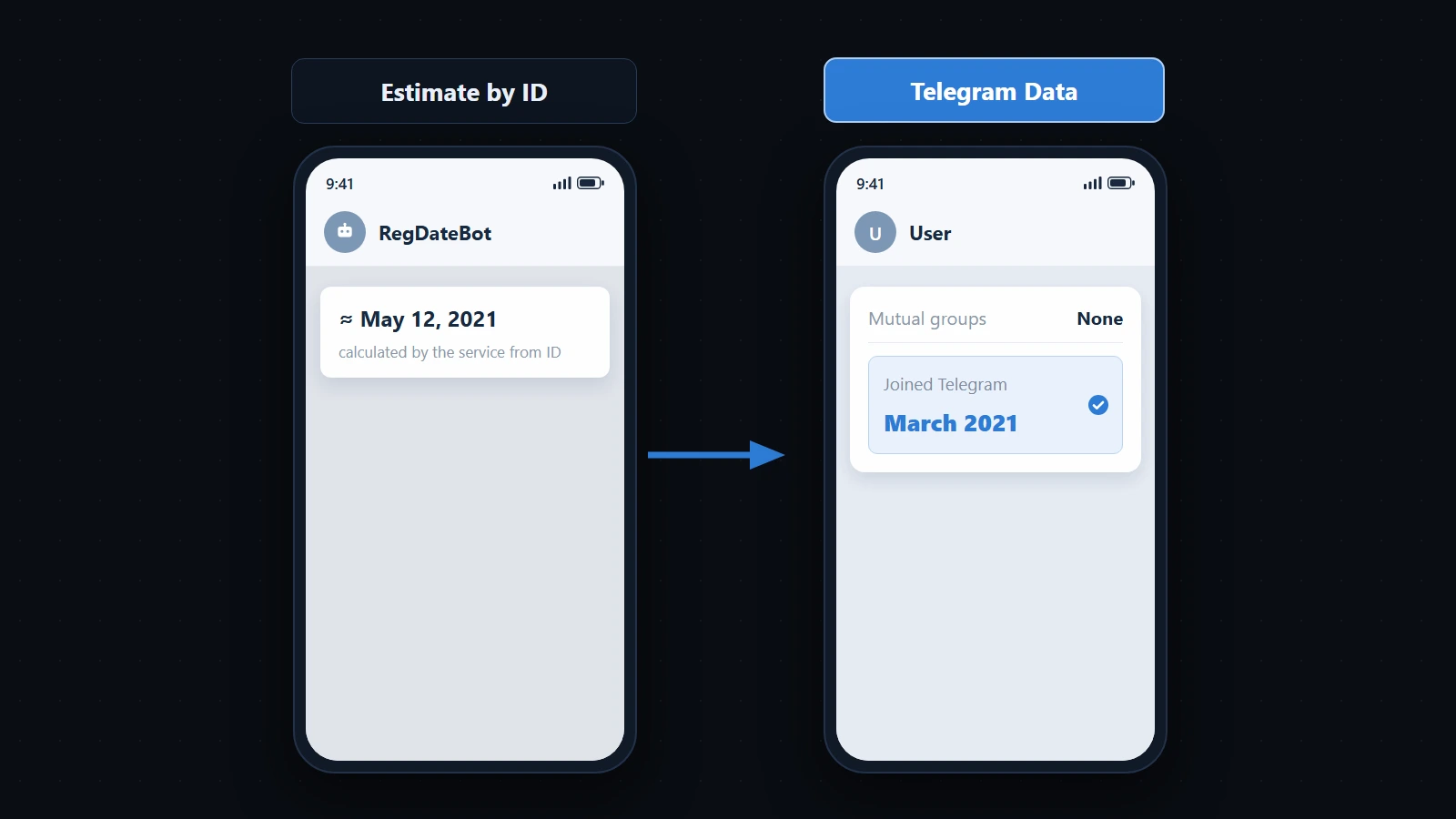
Telegram states the month
The panel on a first message from a stranger names the month and year that person joined. The value comes from Telegram.
It gives a month, not a day; it exists only for someone who wrote to you first; and Telegram’s own schema marks it optional, so it is not always there.
Activity you can still open
A message, a post or a comment you can load yourself shows the account already existed on that date.
It marks a date the account existed by, never the date it started, and it survives only as long as nobody deletes the message.
A calculation from the numeric ID
A service compares the ID against pairs of IDs and known signup dates it collected, and returns roughly when accounts in that range appeared.
That is the service’s own dataset rather than Telegram’s record, and Telegram has never published either those dates or a guarantee that identifiers are issued in strict order.
What the profile looks like
A new photo, an empty bio, a username nobody recognises, a handful of messages.
All of it can be changed in a minute on an account that has existed for ten years.
Jump to a section
What Telegram shows you, and when
On 7 March 2025 Telegram added a panel for messages from people you do not know. Open a new chat from someone outside your contacts and, before you type anything back, the app tells you a few things about the sender.
- the country their phone number belongs to, rather than the number itself;
- any groups the two of you are both in;
- when they joined Telegram;
- when the account last changed its name or its picture;
- whether it is an official account, one verified by a third party, or an ordinary user.
Telegram calls the panel Contact Confirmation and says the joining line is there to help you spot fresh accounts. The API documentation is blunter still: the values are set when a user contacts you for the first time, and they exist to help you detect and block spam or recently hijacked accounts.
So the panel is a check on a stranger who wrote to you first. It is not a lookup you can point at an account of your choosing, and there is no version of it for an account you already know.
It is a month, not a day
Telegram’s client API documents the value behind that line. It is a string in MM.YYYY form, the registration month and the registration year, and there is no day in it anywhere.
So when a bot or a website gives you an exact calendar date for a Telegram account, that precision did not come from Telegram, because Telegram does not publish a day.
The same schema marks each of these values optional, so the panel can arrive with rows missing. A panel with no joining line is not telling you the account is suspicious, or new, or anything else. It is telling you nothing.
When the panel does not appear at all
Four things have to be true at once: the sender is outside your contacts, they wrote first, the conversation is new, and you are on a current official app. None of the common cases qualifies: an old contact, a chat that has been running for a year, a profile you found through search, or your own account.
Nothing is broken when the panel does not show up. The rest of this guide is about the situations where it will not.
One question, two very different answers
Telegram’s figure and a bot’s figure look alike on a screen and are not the same kind of fact. The gap between them is not a matter of degree.
| Criterion | What Telegram reports | What a service calculates |
|---|---|---|
| Where the number comes from | Telegram’s servers, on a documented field | A dataset the service assembled on its own |
| How precise it is | A month and a year | Whatever it chooses to print, including a day nothing supports |
| When you can get it | Only when someone outside your contacts messages you first | Any time you hold an identifier |
| Whether a bot can read it | No. The method that carries it is documented for user accounts only | Yes, and that is exactly how such bots work |
| What it costs you | Nothing. The chat is already open in front of you | You hand an identifier to a service you know nothing about |
The fourth row is the one that closes the question. The call carrying that month is closed to bots, and Telegram’s own documentation says so. Whatever a creation-date bot puts on your screen, then, it is not the figure Telegram publishes. It cannot be.
There is a neat illustration of the confusion on Telegram’s public bug tracker. A user filed a report that a creation-date bot had dated their account to February 2025, years after they believed they had registered. The thread went nowhere: another user pointed out that the bot is not Telegram’s, and the report was closed without a reply from Telegram. Neither, of course, is the date Telegram’s.
When did I join Telegram?
This is the most common version of the question and it has the least satisfying answer: you cannot look it up. Your profile does not carry the date. Settings does not carry it. Telegram’s FAQ does not discuss account creation dates at all.
The strongest test is the full data export. Telegram Desktop will produce a complete archive of your account, and Telegram documents exactly what the personal-information part of it contains:
- your numeric user ID;
- your phone number;
- your first and last name;
- your username;
- your bio.
No date of any kind for the account itself. There is a creation date elsewhere in that archive, but it belongs to each active login session rather than to the account: it records when that particular sign-in began, which for most people is an ordinary day years after they joined. Sessions you have already ended are not in there at all.
There is one genuine oddity in all this. The month and year you registered is real Telegram data, and Telegram does hand it out. It goes to the people you message for the first time, in the panel described above. It never comes back to you.
What you can do instead
Bracket it. Your oldest surviving chat, the earliest picture in the profile-photo history inside your export, the first channel you joined and can still open: each of those fixes a date the account definitely existed by. Put an ID-based estimate on the other side of the bracket and you will usually land on the right year, sometimes within a few months.
For nearly every reason people ask, that is enough.
Checking an account that is not your own
What is available to you depends almost entirely on how that account reached you. Find your situation below before you go looking for a tool.
You want to know how old somebody else’s Telegram account is.
They are outside your contacts and they messaged you first
Open the chat and read the panel before you reply. The line you want names the month and year they joined.
An answer from Telegram, in the one situation Telegram offers one.
You already have a conversation with them, or they are in your contacts
The panel is not offered here, and there is no way to bring it up. You are down to an estimate from the numeric ID, plus whatever old activity of theirs you can still open yourself.
An approximate age, which should be quoted as approximate.
You have the numeric ID, or a message of theirs that was forwarded to you
A service can turn that into an estimated range of months. Send the identifier and nothing else, and expect a range rather than a date.
A figure worth one sentence of a decision, not the whole decision.
You have only a username, or a profile you came across in a search
Some services will resolve a username to an ID and estimate from there, and some will not. Either way you are two steps from anything Telegram said.
The weakest of the four answers, and the one most often repeated as fact.
Notice what none of the four gives you: a guaranteed exact day. Telegram publishes no field a service could look the day up in, so there is nothing to retrieve, only something to compute.
Why a numeric ID is not a creation date
Every account has a number, and Telegram’s Bot API documents it plainly. The user object it returns carries id alongside the name, the username, the language code and a set of capability flags. There is no registration_date, no created_at, and nothing else in that object that holds a time.
So where does an instant answer come from? From interpolation. People collect anchor points: accounts whose real signup date is known. A service then places the number you gave it between the two nearest anchors it happens to hold, and what comes back is a reading taken off a curve drawn through other people’s data.
Nothing Telegram publishes says an ID contains a timestamp, or that identifiers are handed out in strict order. The method leans on something weaker than either: numbers issued later tend to be larger. A tendency is enough to place an account in the right year and not enough to place it in the right week, and the curve is only defined where somebody collected an anchor. Telegram also widened the range of user identifiers during 2021, a change it announced to bot developers in March that year, and a smooth curve does not account for it.
Which is why precision is the tell. A service that answers with a month and a year is describing what it actually did. One that answers to the day, instantly, for any account you name, is printing more digits than its method has.
An ID tells you roughly where an account stands in a queue. It does not tell you when the queue reached that point.
What an old message actually proves
This is where most of the confusion lives, and the correction fits in one sentence: old activity proves an account already existed by a certain date, and never proves it was created on that date.
| What you looked at | What it actually tells you | Does it date the account? |
|---|---|---|
| The oldest message in a private chat | What it actually tells youWhen that conversation started | Does it date the account?No |
| The earliest public post you can find | What it actually tells youThe account existed by then | Does it date the account?No. It only rules out later dates |
| A first message in a group | What it actually tells youWhen the account became visible in that group | Does it date the account?No |
| An old username or profile picture | What it actually tells youPart of the profile’s change history, where any of it is visible | Does it date the account?No |
| Traffic figures on the phone | What it actually tells youHow long this copy of the app has been counting | Does it date the account?No |
| The creation date of a channel they run | What it actually tells youThe age of the channel | Does it date the account?No. A channel is a different object |
| The panel Telegram shows for a new sender | What it actually tells youThe month and year Telegram says they joined | Does it date the account?Yes, in that one situation |
Take the strongest version of it. Suppose the oldest thing you can open from an account is a comment it left under a channel post three years ago. That establishes one fact and one only: the account was already in existence three years ago. It may have been made the week before that comment, or it may have been sitting untouched since 2014, and the comment looks identical in both worlds.
The evidence is also destructible, which is the half most write-ups leave out. In a private chat either party can delete a message for everyone, and since 2019 there has been no time limit on doing it. Deleting an account clears what it stored in Telegram’s cloud, although the people it wrote to may still hold their own copies. So the oldest thing you can find reflects what survived deletion and what happens to be visible to you. Finding no old traces at all is not evidence of a young account.
A channel is not its owner
Channel and group ages get quoted as though they belonged to whoever runs them, and they do not. Ownership is transferable by design: an owner can hand a channel or a group to another member at any time, a group whose owner walks away passes to one of its admins automatically after a week, and a channel whose creator deleted their account is simply left without one while its admins carry on. A channel from 2016 can be run today by an account made in 2025, and nothing in the interface will show you that.
The Data and Storage date is not a registration date
One old instruction keeps circulating, and the search results are still full of it: open Data and Storage, find the network usage figures, and read the date they run from as the day you joined Telegram.
It is not that. Telegram labels the figure on the same line: network usage since a given date. Those figures count traffic for this installation of the app, on this device, and the date is when that counter started.
- Install Telegram on a new phone and the date is today, for an account of any age.
- Reinstall the app or clear its data and the date restarts.
- Press the button that resets the statistics and the date restarts again.
- On some clients the mobile-data and Wi-Fi figures are counted separately and can be reset separately, so the date beside one need not match the date beside the other.
That last one settles it on its own. A single account cannot have been created on two different dates, so whatever those dates describe, it is not the account.
The screen is a very weak bound at best. The counter can only have started after registration, never before it, so a counter running since 2019 does at least mean the account is older than that. A reset, a reinstall or a new phone erases even that much. What the screen answers well is a different question: how long Telegram has been running on this particular device.
Creation date, account age, and what the figure is for
Almost nobody who asks this wants a date. They want to know whether the account in front of them is old or new, and a year settles that question in a way a calendar day does not improve on.
So the two phrasings people search for, the creation date and the account age, are one question with two labels, and the approximate answer is the useful one. Knowing an account is somewhere around three years old resolves almost everything worth asking about its age. Knowing the exact day resolves very little.
Age also turns up as a stated attribute rather than a question. In the DragonSIM catalog the age of the current batch is published per country, beside the formats and what is in stock, because it is one of the things people compare before they buy. Where the figure is published rather than deduced, the only thing that changes is who did the measuring. It still dates the account and still says nothing about how Telegram will treat it on your machine.
What to do with the answer
How much the figure is worth depends on why you went looking for it. Three common reasons, and what each one can honestly conclude:
A stranger arrives with a business proposal
Read the panel first, then weigh it against what they are claiming
- An account created last month presenting itself as a long-running company is a mismatch worth noticing.
- It is a signal and not a verdict: accounts are bought, borrowed and taken over.
- Check the claim itself, not only the age of the profile making it.
You are curious about your own account
Accept a month or a year and stop there
- Nothing official prints the day for you, including a full data export.
- Your own oldest chat usually gets you close enough on its own.
- A service promising more precision than that is promising something it cannot have.
Somebody tells you an account is old, as if that settled something
Treat age as one input and keep the others
- The figure describes the account, and accounts outlive whoever set them up.
- Delete an account and sign up again on the same number and Telegram treats you as a new user, with none of the old history behind it.
- A new account is not automatically a fraud and an old one is not automatically safe.
If you keep one thing from this page, keep this: every number on this subject except that one month was worked out by somebody, and is worth exactly what their working is worth.
When the age is stated up front
Everything above is about reconstructing a figure nobody published. There is a version of this where that work does not exist at all: the age is declared before the purchase, and you read it instead of estimating it.
Common questions
How do I check when a Telegram account was created?
There is no single check, and that is the answer rather than a dodge. Telegram itself replies only when a stranger opens a conversation with you, and even then it gives a month rather than a day. For every other account the figure comes from inference, and what it is worth depends entirely on which inference produced it.
Can I see when I joined Telegram?
Not from anywhere in the app, and not from a full export either: what Telegram writes down about you there is who you are, not when you arrived. The nearest thing to an answer is the oldest conversation you can still open. That is a date you were definitely here by, and it is usually closer to the truth than people expect.
Can I check a Telegram account’s age by ID?
You can get an estimate. The ID identifies the account, and services that answer these queries compare it against pairs of IDs and known signup dates they collected themselves. Telegram documents no field that turns an ID into a registration date, so anything that comes back is that service’s calculation rather than Telegram’s record.
Does Telegram show when someone joined?
Yes, in one situation. Since March 2025, when a person outside your contacts messages you for the first time, Telegram shows a panel about them that includes when they joined, along with the country of their number, any groups you share and when the account last changed its name or picture. You cannot open that panel for an account of your choosing.
Are Telegram creation-date bots accurate?
They are approximations, and the honest ones say so. A bot cannot reach the figure Telegram publishes, so it is calculating one instead, from a collection of identifiers and dates it assembled itself. Read the answer as a rough range of months, and be more sceptical the more precise it looks.
Does an old Telegram account mean it is trustworthy?
No. Age tells you when an account started, not who is behind it now. Accounts change hands, sit unused for years, or are made early precisely so they look established later. Treat it as one signal among everything else you check, and never as a substitute for the rest.
Does the oldest message show when an account was created?
No. It shows the account already existed when that message was sent. An account made in 2016 and first used in 2022 leaves exactly the same trace as one made in 2022, and because either party can delete messages at any time, even that trace only reflects what nobody removed.
Does the Data and Storage screen show my registration date?
No. That date belongs to a counter rather than to an account: it begins when the app starts counting on that phone and restarts whenever you reset it, reinstall, or move to a new device. On some clients the mobile and Wi-Fi counters can disagree with each other, which is the shortest proof that neither is describing the account.
Why do two services give different dates for the same account?
Because each one is reading its own collection of identifiers and known signup dates, and no two collections are the same. Neither is looking anything up at Telegram, so there is no shared record for them to agree on. Where they differ by months, treat the overlap as the answer; where they differ by years, treat both as unusable.
Primary sources
- Telegram, 7 March 2025: the release that added the panel for a first message from a strangertelegram.org/blog
- The field behind that line, and the MM.YYYY format it is documented incore.telegram.org
- When those values are set, and what Telegram says they are forcore.telegram.org/api
- The call that carries those settings, and who Telegram documents it forcore.telegram.org
- Bot API: every documented field of the user object, and no date among themcore.telegram.org/bots/api
- What a full data export contains, field by fieldcore.telegram.org/import-export
- Telegram, 24 March 2019: deleting messages you sent or received, with no time limittelegram.org/blog
- Telegram’s FAQ: silent on creation dates, explicit that a new signup is a new usertelegram.org/faq
- Telegram’s bug tracker: a creation-date bot reported years out, and the reply it gotbugs.telegram.org